Pokémon TCG eras and sets: from Base Set to Mega Evolution
Every Pokémon TCG era in order: how its cards look, which rarities and mechanics it introduced, and how to tell what set a card is from by its symbol, set code and number. With set lists and prices from our catalog.
PokeTrail10 min read
A set is a release of cards that came out together and share one numbering: Base Set, Evolving Skies, 151. An era is a few years of sets that follow one generation of the video games: Diamond & Pearl, Sword & Shield, Scarlet & Violet. Each era changes how cards look, how they play and which rarities exist, so for a collector the era is the first clue to what a card is and what it might be worth.
This guide walks through every era from 1999 to today. For each one: what it introduced and what collectors hunt for in it, followed by its sets from our catalog, with logos, card counts, the total value of each set and the era’s most expensive card. That data updates daily.
One caveat. We’re talking about the English-language sets, the ones TCGplayer and Cardmarket price. Japanese sets come out earlier and are put together differently: one English set is often built from two or three Japanese ones (Paldea Evolved combines the Japanese Snow Hazard and Clay Burst). So news and prices from the Japanese market don’t always apply to the English version of a card.
How to tell what set a card is from
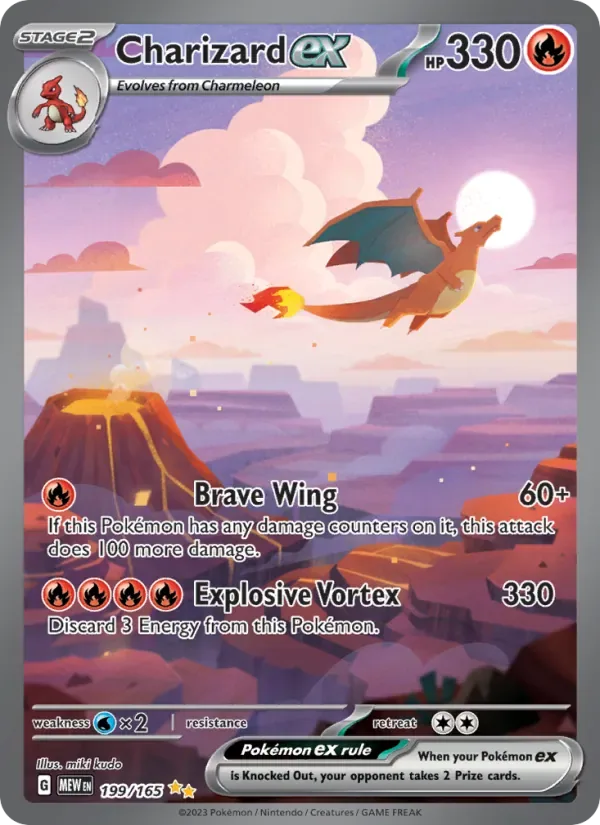
Everything you need is printed on the card. Compare a Scyther from the second set of 1999 with a Charizard ex from 151 (2023):
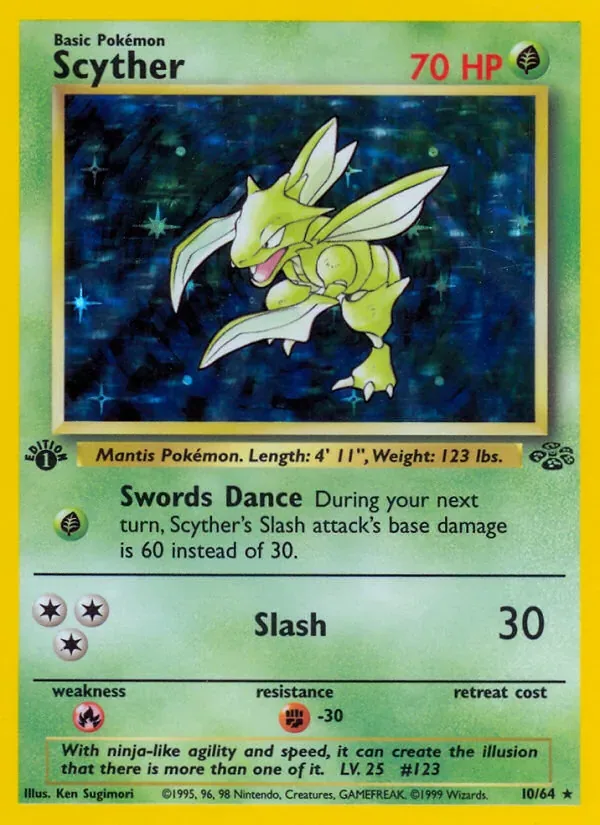
- Set symbol. A small emblem: right under the artwork on the earliest sets, later at the bottom of the card next to the number. Jungle’s is a flower. The original Base Set has no symbol at all, so a 1999–2000 card without one is most likely Base Set.
- Number and set size. 10/64 is card ten of 64. When the first number is higher than the second, it’s a secret rare outside the main list.
- 1st Edition stamp. Not about the set but the print run: the first printing of the sets from Base Set to Neo Destiny (1999–2002). The same set has cards with and without it, and Legendary Collection and the e-Card sets have no stamp at all.
- Yellow border. Almost every English card before 2023 has one.
- Regulation mark (G). Used for tournament formats: it tells you whether a card is legal in Standard. Printed since the Sword & Shield era.
- Set code (MEW is 151, followed by the language, EN). Since Scarlet & Violet the code replaces the symbol, and it’s the easiest way to identify a set: PAL is Paldea Evolved, OBF Obsidian Flames, PRE Prismatic Evolutions.
- Number 199/165: a secret rare, numbered past the 165 cards of the main list.
- Silver border. With Scarlet & Violet, the border of English cards turned from yellow to silver.
The fastest way to find a card is to type its number into the PokeTrail search: “199/165” or “charizard 199” shows every card with that number, with the set under each one.
The eras in order
From oldest to newest. Years follow the release of the main English sets, leaving out promos and reprints.
Wizards of the Coast, 1999–2003
For the first four years, Wizards of the Coast published the cards in North America and Europe: from Base Set (1999) through Gym and Neo to the e-Card series (Expedition, Aquapolis, Skyridge). This is where all the classics come from: the holo Charizard, Blastoise and Venusaur of Base Set, the 1st Edition stamp on first prints, the first secret rare (Dark Raichu 83/82 in Team Rocket, 2000), and the Shining Pokémon of Neo Revelation and Neo Destiny. Legendary Collection (2002) brought reverse holos, and the e-Card sets added e-Reader dot code strips along the card’s edge.
It’s the most expensive era: few cards survive in good condition, and demand runs on nostalgia. For the same reason, old cards are where most fakes are.
 Base Set1999 · 102 cardsCard value: $2,256
 Jungle1999 · 64 cardsCard value: $1,125
 Fossil1999 · 62 cardsCard value: $1,217
 Base Set 22000 · 130 cardsCard value: $1,828
 Team Rocket2000 · 83 cardsCard value: $2,043
 Gym Heroes2000 · 132 cardsCard value: $2,150
 Gym Challenge2000 · 132 cardsCard value: $3,243
 Neo Genesis2000 · 111 cardsCard value: $2,188
7 more sets
 Neo Discovery2001 · 75 cardsCard value: $2,648
 Neo Revelation2001 · 66 cardsCard value: $3,771
 Neo Destiny2002 · 113 cardsCard value: $10,253
 Legendary Collection2002 · 110 cardsCard value: $3,367
 Expedition Base Set2002 · 165 cardsCard value: $10,860
 Aquapolis2003 · 186 cardsCard value: $20,129
 Skyridge2003 · 182 cardsCard value: $24,843
18 sets · 1,793 cards in the catalog · 1999–2003
Also: Wizards Black Star Promos, Southern Islands, Best of game
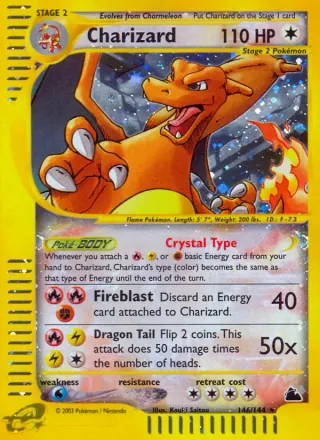 Most expensive card of the eraCharizardSkyridge$3,000
EX, 2003–2007
In 2003 The Pokémon Company took over publishing, and the first set of the new era, Ruby & Sapphire, redesigned the cards. The headline mechanic is Pokémon-ex, written in lowercase: a stronger Pokémon that gives your opponent two Prize cards when it’s Knocked Out. Team Rocket Returns (2004) introduced Gold Stars, shiny Pokémon with a star after the name, two or three per set. Delta Species and Holon Phantoms added δ Pokémon of unusual types.
For collectors, EX is the Gold Star era: these are among the most expensive cards after the Wizards classics, and the ex cards themselves are hard to find in good condition too.
 Ruby & Sapphire2003 · 109 cardsCard value: $2,526
 Sandstorm2003 · 100 cardsCard value: $2,901
 Dragon2003 · 100 cardsCard value: $5,433
 Team Magma vs Team Aqua2004 · 97 cardsCard value: $4,952
 Hidden Legends2004 · 102 cardsCard value: $3,331
 FireRed & LeafGreen2004 · 116 cardsCard value: $6,451
 Team Rocket Returns2004 · 111 cardsCard value: $35,175
 Deoxys2005 · 108 cardsCard value: $8,177
8 more sets
 Emerald2005 · 107 cardsCard value: $4,218
 Unseen Forces2005 · 117 cardsCard value: $13,662
 Delta Species2005 · 114 cardsCard value: $15,774
 Legend Maker2006 · 93 cardsCard value: $5,663
 Holon Phantoms2006 · 111 cardsCard value: $12,672
 Crystal Guardians2006 · 100 cardsCard value: $5,740
 Dragon Frontiers2006 · 101 cardsCard value: $12,034
 Power Keepers2007 · 108 cardsCard value: $7,568
19 sets · 1,767 cards in the catalog · 2003–2007
Also: Nintendo Black Star Promos, Poké Card Creator Pack, Unseen Forces Unown Collection
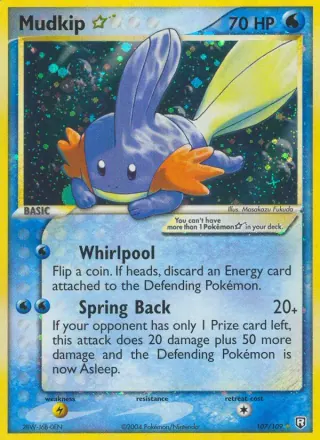 Most expensive card of the eraMudkip ☆Team Rocket Returns$9,762
Diamond & Pearl and Platinum, 2007–2009
The era’s signature rarity is LV.X: a card placed on top of the regular version of the same Pokémon to power it up. Platinum introduced SP Pokémon that belong to trainers: Team Galactic, Gym Leaders, the Elite Four, the Champion (marked G, GL, 4, C or FB after the name), and a few sets had shiny cards numbered SH.
These sets are relatively cheap and little known to newer collectors, though LV.X cards of popular Pokémon hold their value.
 Diamond & Pearl2007 · 130 cardsCard value: $1,153
 Mysterious Treasures2007 · 124 cardsCard value: $1,238
 Secret Wonders2007 · 132 cardsCard value: $2,174
 Great Encounters2008 · 106 cardsCard value: $1,464
 Majestic Dawn2008 · 100 cardsCard value: $2,741
 Legends Awakened2008 · 146 cardsCard value: $2,448
 Stormfront2008 · 106 cardsCard value: $2,002
 Platinum2009 · 133 cardsCard value: $2,444
3 more sets



13 sets · 1,433 cards in the catalog · 2007–2009
Also: DP Black Star Promos, Pokémon Rumble
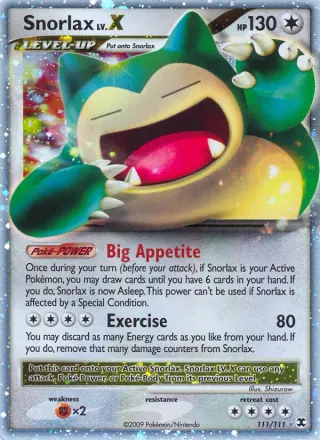 Most expensive card of the eraSnorlax LV.XRising Rivals$1,000
HeartGold & SoulSilver and Call of Legends, 2010–2011
A short era of four sets plus Call of Legends. Its rarities are Prime, strong Pokémon marked PRIME, and LEGEND: one illustration of a legendary Pokémon split across two cards played side by side. Call of Legends had its own shiny legendaries, numbered SL.
 HeartGold SoulSilver2010 · 124 cardsCard value: $3,533
 Unleashed2010 · 96 cardsCard value: $2,839
 Undaunted2010 · 91 cardsCard value: $4,838
 Triumphant2010 · 103 cardsCard value: $3,084
 Call of Legends2011 · 106 cardsCard value: $9,117
6 sets · 545 cards in the catalog · 2010–2011
Also: HGSS Black Star Promos
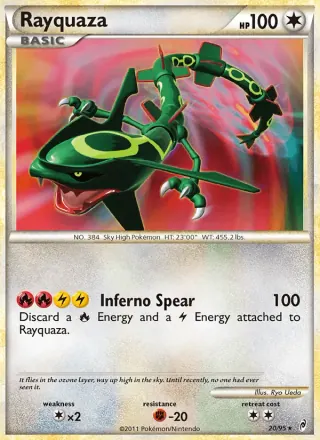 Most expensive card of the eraRayquazaCall of Legends$972
Black & White, 2011–2013
This is where the modern look of collectible cards begins. The very first set had full art Reshiram and Zekrom, with artwork across the whole card and a textured surface, and Noble Victories brought the first full art Trainer, N. From Next Destinies (2012) came Pokémon-EX, now in capitals, each in a regular and a full art version. Secret rares existed before, but from Black & White on almost every set has them, and Boundaries Crossed (2012) introduced ACE SPEC cards.
 Black & White2011 · 115 cardsCard value: $555
 Emerging Powers2011 · 98 cardsCard value: $115
 Noble Victories2011 · 102 cardsCard value: $902
 Next Destinies2012 · 103 cardsCard value: $2,846
 Dark Explorers2012 · 111 cardsCard value: $4,399
 Dragons Exalted2012 · 128 cardsCard value: $3,337
 Boundaries Crossed2012 · 153 cardsCard value: $3,640
 Plasma Storm2013 · 138 cardsCard value: $6,027
3 more sets



13 sets · 1,437 cards in the catalog · 2011–2013
Also: BW Black Star Promos, Dragon Vault
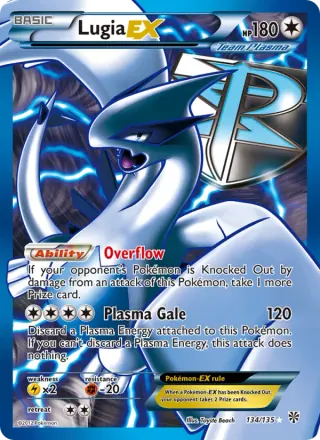 Most expensive card of the eraLugia-EXPlasma Storm$2,717
XY, 2013–2016
Mega Evolution entered the game as Mega EX: a Pokémon-EX evolves into its Mega form, but that ends your turn. BREAKthrough (2015) added BREAK, horizontal cards with gold borders placed on top of the regular card. The era ended with Evolutions (2016), which recreated the original Base Set design for the game’s 20th anniversary, and Generations had its own Radiant Collection.
Thanks to Evolutions, even people who never collected XY know it: it’s a reprint of the classics that is easy to mistake for the 1999 original.
 Kalos Starter Set2013 · 39 cardsCard value: $155
 XY2014 · 146 cardsCard value: $861
 Flashfire2014 · 110 cardsCard value: $1,746
 Furious Fists2014 · 114 cardsCard value: $899
 Phantom Forces2014 · 124 cardsCard value: $2,942
 Primal Clash2015 · 164 cardsCard value: $2,045
 Double Crisis2015 · 34 cardsCard value: $1,207
 Roaring Skies2015 · 112 cardsCard value: $1,990
7 more sets
 Ancient Origins2015 · 101 cardsCard value: $3,436
 BREAKthrough2015 · 165 cardsCard value: $1,452
 BREAKpoint2016 · 126 cardsCard value: $1,073
 Generations2016 · 117 cardsCard value: $1,845
 Fates Collide2016 · 129 cardsCard value: $864
 Steam Siege2016 · 116 cardsCard value: $434
 Evolutions2016 · 113 cardsCard value: $797
16 sets · 1,926 cards in the catalog · 2013–2016
Also: XY Black Star Promos
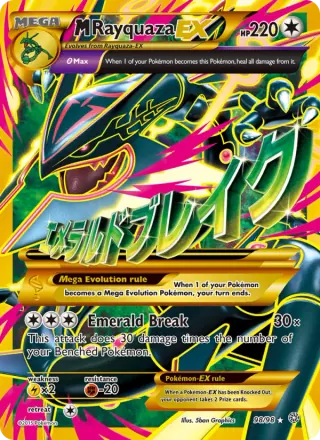 Most expensive card of the eraM Rayquaza EXAncient Origins$1,118
Sun & Moon, 2017–2019
The GX mechanic: strong Pokémon with one GX attack you can use only once per game. Team Up (2019) added Tag Teams, two or three Pokémon on one card. Prism Star (from Ultra Prism, 2018) marks cards you can have only one of in a deck. Secret rares multiplied: rainbow and gold versions of full arts, so Sun & Moon sets have dozens of cards numbered past the set size. Hidden Fates (2019) had a separate Shiny Vault subset of shiny Pokémon.
Full art Tag Teams with their own scene illustration (collectors call them “alt arts”) are the era’s most expensive cards.
 Sun & Moon2017 · 172 cardsCard value: $657
 Guardians Rising2017 · 169 cardsCard value: $1,110
 Burning Shadows2017 · 169 cardsCard value: $1,894
 Shining Legends2017 · 81 cardsCard value: $1,579
 Crimson Invasion2017 · 125 cardsCard value: $513
 Ultra Prism2018 · 173 cardsCard value: $2,307
 Forbidden Light2018 · 146 cardsCard value: $1,384
 Celestial Storm2018 · 183 cardsCard value: $2,107
7 more sets
 Dragon Majesty2018 · 80 cardsCard value: $774
 Lost Thunder2018 · 236 cardsCard value: $3,036
 Team Up2019 · 196 cardsCard value: $12,216
 Unbroken Bonds2019 · 234 cardsCard value: $4,181
 Unified Minds2019 · 258 cardsCard value: $5,007
 Hidden Fates2019 · 69 cardsCard value: $255
 Cosmic Eclipse2019 · 271 cardsCard value: $6,550
18 sets · 2,922 cards in the catalog · 2017–2019
Also: SM Black Star Promos, Detective Pikachu, Hidden Fates Shiny Vault
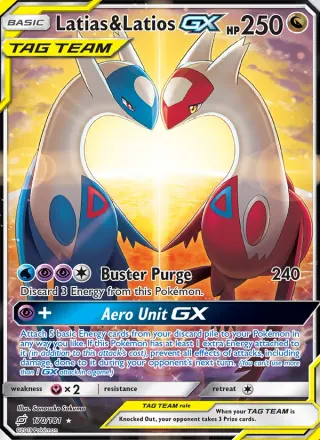 Most expensive card of the eraLatias & Latios GXTeam Up$3,858
Sword & Shield, 2020–2023
The era with the most sets. Its mechanics are V and VMAX (Gigantamax forms, from the first set), VSTAR (from Brilliant Stars, 2022), four-card V-UNIONs, Radiant Pokémon (one shiny per deck) and Amazing Rares on a rainbow background. Cards gained the regulation mark (see above).
For collectors, the heart of this era is the alternate art V and VMAX cards (“alt arts”), above all in Chilling Reign and Evolving Skies (2021). Moonbreon, the Evolving Skies Umbreon VMAX, is one of the best-known modern cards. From Brilliant Stars on, each set had a Trainer Gallery of Pokémon together with their trainers, and Crown Zenith had a Galarian Gallery.
 Sword & Shield2020 · 216 cardsCard value: $534
 Rebel Clash2020 · 209 cardsCard value: $503
 Darkness Ablaze2020 · 201 cardsCard value: $241
 Champion's Path2020 · 80 cardsCard value: $485
 Vivid Voltage2020 · 203 cardsCard value: $512
 Shining Fates2021 · 73 cardsCard value: $74.68
 Battle Styles2021 · 183 cardsCard value: $773
 Chilling Reign2021 · 233 cardsCard value: $1,954
8 more sets
 Evolving Skies2021 · 237 cardsCard value: $7,697
 Fusion Strike2021 · 284 cardsCard value: $2,175
 Brilliant Stars2022 · 186 cardsCard value: $698
 Astral Radiance2022 · 216 cardsCard value: $865
 Pokémon GO2022 · 88 cardsCard value: $339
 Lost Origin2022 · 217 cardsCard value: $1,340
 Silver Tempest2022 · 215 cardsCard value: $887
 Crown Zenith2023 · 160 cardsCard value: $218
26 sets · 3,675 cards in the catalog · 2020–2023
Also: SWSH Black Star Promos, Pokémon Futsal 2020, Shining Fates Shiny Vault, Celebrations, Celebrations Classic Collection, Brilliant Stars Trainer Gallery, Astral Radiance Trainer Gallery, Lost Origin Trainer Gallery, Silver Tempest Trainer Gallery, Crown Zenith Galarian Gallery
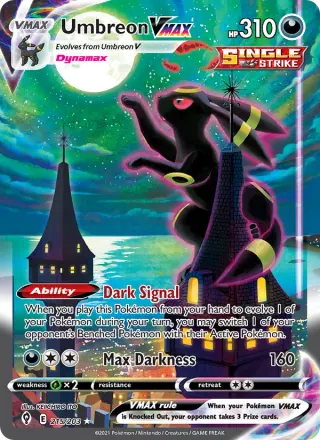 Most expensive card of the eraUmbreon VMAXEvolving Skies$2,167
Scarlet & Violet, 2023–2025
The era that changed how English cards look: a silver border instead of yellow, and a set code instead of a symbol. The ex mechanic returned in lowercase, as in 2003, and Tera Pokémon ex, with crystal-like artwork, can’t be damaged while on the Bench. ACE SPECs came back in Temporal Forces (2024).
The biggest change for collectors is the new rarity system: the color and number of stars show the rarity, and Illustration Rares and Special Illustration Rares became what most people open packs for. Our Pokémon card rarities guide covers them in detail. Scarlet & Violet sets have more secret rares than ever: Paldea Evolved and Black Bolt each have over 80.
 Scarlet & Violet2023 · 258 cardsCard value: $635
 Paldea Evolved2023 · 279 cardsCard value: $1,635
 Obsidian Flames2023 · 230 cardsCard value: $378
 1512023 · 207 cardsCard value: $1,446
 My First Battle2023 · 32 of 48 cardsCard value: $53.42
 Paradox Rift2023 · 266 cardsCard value: $1,059
 Paldean Fates2024 · 245 cardsCard value: $2,372
 Temporal Forces2024 · 218 cardsCard value: $1,065
9 more sets
 Twilight Masquerade2024 · 226 cardsCard value: $1,030
 Shrouded Fable2024 · 99 cardsCard value: $736
 Stellar Crown2024 · 175 cardsCard value: $536
 Surging Sparks2024 · 252 cardsCard value: $987
 Prismatic Evolutions2025 · 180 cardsCard value: $3,780
 Journey Together2025 · 190 cardsCard value: $350
 Destined Rivals2025 · 244 cardsCard value: $1,179
 Black Bolt2025 · 172 cardsCard value: $2,873
 White Flare2025 · 173 cardsCard value: $2,552
19 sets · 3,696 cards in the catalog · 2023–2025
Also: Scarlet & Violet Energy, SVP Black Star Promos
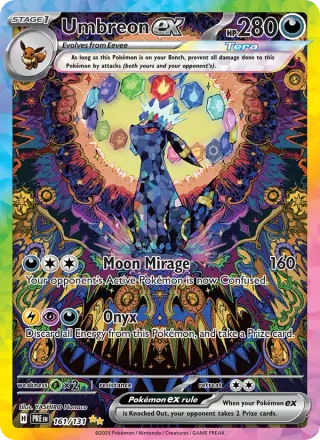 Most expensive card of the eraUmbreon exPrismatic Evolutions$1,130
Mega Evolution, 2025 onward
The current era brought Mega Evolution back as Mega Pokémon ex. The rarity system carried over from Scarlet & Violet, with a new top tier, Mega Hyper Rare, the rarest card of a set and only for Mega Pokémon. For the game’s 30th anniversary, 2026 saw 30th Celebration with rarities of its own and a Classic Collection subset reprinting cards from every earlier era.
 Mega Evolution2025 · 188 cardsCard value: $1,209
 Phantasmal Flames2025 · 130 cardsCard value: $872
 Ascended Heroes2026 · 295 cardsCard value: $3,057
 Perfect Order2026 · 124 cardsCard value: $412
 Chaos Rising2026 · 122 cardsCard value: $407
 Pitch Black2026 · 120 cardsCard value: $491
 30th Celebration2026 · 161 cardsCard value: $12,413
10 sets · 1,298 cards in the catalog · 2025–2026
Also: Mega Evolution Energy, MEP Black Star Promos, 30th Classic Collection
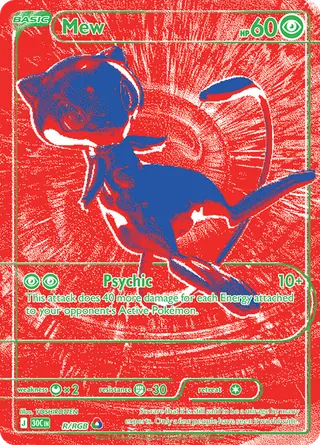 Most expensive card of the eraMew30th Celebration$4,317
Side series and promos
Some releases belong to no era because they run alongside several:
- POP Series (2004–2009): small 17-card sets handed out at tournaments and events. Some have their own Gold Stars.
- Trainer Kits: two half-decks for learning to play, with their own numbering.
- McDonald’s Collection: cards from McDonald’s kids’ meals, almost every year since 2011, often with their own stamp.
- Black Star Promos: each era’s promo cards, with a black star and the word PROMO instead of a rarity symbol. They come in collection boxes and are given out at prereleases and tournaments. On the sets page they follow the sets of their era.
These cards are rarely expensive, with exceptions: tournament prize promos are printed in tiny numbers.
 EX trainer Kit (Latias)2004 · 10 cardsCard value: $45.05
 EX trainer Kit (Latios)2004 · 10 cardsCard value: $44.05
 POP Series 12004 · 17 cardsCard value: $737
 POP Series 22005 · 17 cardsCard value: $554
 EX trainer Kit 2 (Minun)2006 · 12 cardsCard value: $40.80
 EX trainer Kit 2 (Plusle)2006 · 12 cardsCard value: $27.59
 POP Series 32006 · 17 cardsCard value: $1,009
 POP Series 42006 · 17 cardsCard value: $2,222
33 more sets
 POP Series 52007 · 17 cardsCard value: $15,193
 POP Series 62007 · 17 cardsCard value: $590
 DP trainer Kit (Lucario)2007 · 11 cardsCard value: $18.41
- DP trainer Kit (Manaphy)2007 · 12 cardsCard value: $12.51
 POP Series 72008 · 17 cardsCard value: $321
 POP Series 82008 · 17 cardsCard value: $219
 POP Series 92009 · 17 cardsCard value: $207
 HS trainer Kit (Gyarados)2010 · 27 of 30 cardsCard value: $112
- HS trainer Kit (Raichu)2010 · 30 cardsCard value: $94.06
 McDonald's Collection 20112011 · 12 cardsCard value: $102
 BW trainer Kit (Excadrill)2011 · 30 cardsCard value: $16.85
- BW trainer Kit (Zoroark)2011 · 30 cardsCard value: $15.39
 McDonald's Collection 20122012 · 12 cardsCard value: $134
 XY trainer Kit (Noivern)2014 · 30 cardsCard value: $23.82
- XY trainer Kit (Sylveon)2014 · 30 cardsCard value: $112
 McDonald's Collection 20142014 · 12 cardsCard value: $218
- XY trainer Kit (Bisharp)2014 · 30 cardsCard value: $66.07
- XY trainer Kit (Wigglytuff)2014 · 30 cardsCard value: $129
- XY trainer Kit (Latias)2015 · 30 cardsCard value: $18.93
- XY trainer Kit (Latios)2015 · 30 cardsCard value: $24.07
 McDonald's Collection 20152015 · 12 cardsCard value: $288
- XY trainer Kit (Pikachu Libre)2016 · 30 cardsCard value: $102
- XY trainer Kit (Suicune)2016 · 30 cardsCard value: $16.33
 McDonald's Collection 20162016 · 12 cardsCard value: $1,273
 SM trainer Kit (Lycanroc)2017 · 17 of 30 cardsCard value: $3.24
- SM trainer Kit (Alolan Raichu)2017 · 17 of 30 cardsCard value: $8.78
 McDonald's Collection 20172017 · 12 cardsCard value: $102
 McDonald's Collection 20182018 · 12 cardsCard value: $354
 McDonald's Collection 20192019 · 12 cardsCard value: $197
 McDonald's Collection 20212021 · 25 cardsCard value: $100
 McDonald's Collection 20222022 · 15 cardsCard value: $14.52
 McDonald's Collection 20232023 · 15 cardsCard value: $6.43
 McDonald's Collection 20242024 · 15 cardsCard value: $9.14
41 sets · 777 cards in the catalog · 2004–2024
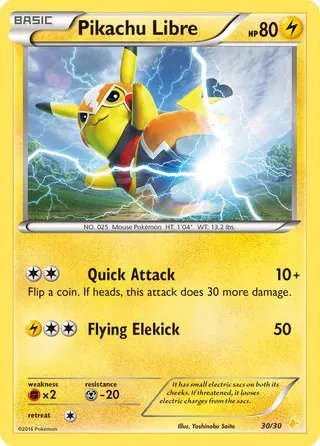 Most expensive card of these seriesPikachu LibreXY trainer Kit (Pikachu Libre)$70.93
Which era to collect
The answer depends on what you want from a collection, not on what might go up in price.
- Wizards of the Coast and EX: nostalgia and the history of the game. Sealed packs are nearly gone, so you buy single cards, and they’re expensive. Condition matters most here, and there are plenty of fakes: check both the seller and the card.
- 2007–2016 (Diamond & Pearl through XY): the cheapest way to complete older sets. Demand is lower, so prices are calmer.
- Sun & Moon and Sword & Shield: packs still turn up but keep getting pricier; the most valuable cards are the alt arts and rainbow rares.
- Scarlet & Violet and Mega Evolution: packs are on store shelves, and prices of new cards are still finding their level in the first months after release. The easiest start for a new collection.
Many collectors pick a Pokémon or an artist rather than an era and collect their cards across all of them. The card catalog has filters by Pokémon, artist and set for exactly that.
All eras in one table
The eras in the PokeTrail catalog: the years of their main sets, the number of sets including promos, the number of cards, and the most expensive card of each. Click an era’s name to open its sets.
| Era | Years | Sets | Cards | Most expensive card |
|---|---|---|---|---|
| Base | 1999–2000 | 6 | 494 | Charizard$1,001 |
| Neo | 2000–2002 | 6 | 493 | Shining Charizard$1,330 |
| Gym | 2000 | 2 | 264 | Blaine's Charizard$597 |
| E-Card | 2002–2003 | 4 | 542 | Charizard$3,000 |
| EX | 2003–2007 | 19 | 1,767 | Mudkip ☆$9,762 |
| Diamond & Pearl | 2007–2008 | 8 | 900 | Charizard$528 |
| Platinum | 2009 | 5 | 533 | Snorlax LV.X$1,000 |
| HeartGold & SoulSilver | 2010–2011 | 6 | 545 | Rayquaza$972 |
| Black & White | 2011–2013 | 13 | 1,437 | Lugia-EX$2,717 |
| XY | 2013–2016 | 16 | 1,926 | M Rayquaza EX$1,118 |
| Sun & Moon | 2017–2019 | 18 | 2,922 | Latias & Latios GX$3,858 |
| Sword & Shield | 2020–2023 | 26 | 3,675 | Umbreon VMAX$2,167 |
| Scarlet & Violet | 2023–2025 | 19 | 3,696 | Umbreon ex$1,130 |
| Mega Evolution | 2025–2026 | 10 | 1,298 | Mew$4,317 |
In short
- An era is a few years of sets tied to a generation of the games; it sets how cards look, play and which rarities exist.
- You can tell a card’s set by its symbol (before 2023) or set code (from Scarlet & Violet on) and its number.
- A yellow border almost always means a card from before 2023; silver means Scarlet & Violet or later.
- The most expensive classics are Wizards of the Coast cards (1999–2003); the biggest modern chases are Sword & Shield alt arts and Scarlet & Violet illustration rares.
- English sets don’t always match Japanese ones: check which version a news story or price is about.
Every set by era is on the Pokémon TCG cards page, single cards with a set filter are in the catalog, and to see how much of a set you already have, add your cards to your collection.